10/10 ARM Construction Loan

If you’re looking for a new home and still finding it hard to find, take matters into your own hands. Build it yourself. Dime’s Jumbo Construction Loan and our team of lending experts can help you open doors.

It's your home. Your bank. Your Dime.
1010Arm Rate Bubble

From a solid foundation to the final roof shingle

Personal attention through the entire building process
Funds released in a timely manner as each construction phase begins
Seamless transition to long-term permanent mortgage

We've got the blueprint for construction loans.

  • No prepayment penalty
  • One year to build
  • Interest-only payments during construction
  • Jumbo + conforming mortgage amounts
  • No points
  • One closing
  • Stick built or modular 
  • Up to 80% loan to value
We make payment easy, too.

All our new construction loans include access to Online and Mobile Banking tools. It's easy to schedule automatic electronic payments so you don't have to write a check every month.

Bill Anderson
VP, Residential Loan Originator
NMLS ID# 1867550
Jeanne M. Lussier
AVP, Residential Loan Originator
NMLS ID# 954464
Katherine E. Morano
AVP, Residential Loan Originator
NMLS ID# 768396
Susan Shepherd
VP, Residential Loan Originator
NMLS ID# 15701

Dime Bank provides home loan solutions to help you buy, refinance, or build, supported by trusted local service across CT and Westerly, RI.

Frequently asked questions

To determine the value of the property you are purchasing or refinancing, an appraisal will be required. An appraisal report is a written description and estimate of the value of the property. National standards govern not only the format for the appraisal; they also specify the appraiser's qualifications and credentials. In addition, most states now have licensing requirements for appraisers evaluating properties located within their states.

The appraiser will create a written report for us and you'll be given a copy at your loan closing. If you'd like to review it earlier, your Loan Originator would be happy to provide it to you.

Usually the appraiser will inspect both the interior and exterior of the home. However, in some cases, only an exterior inspection will be necessary based on your financial strength and the location of the home. Exterior-only inspections usually save time and money, but if you're purchasing a new home, your Loan Originator will contact you to determine if you'd be more comfortable with a full inspection.

After the appraiser inspects the property, they will compare the qualities of your home with other homes that have sold recently in the same neighborhood. These homes are called "comparables" and play a significant role in the appraisal process. Using industry guidelines, the appraiser will try to weigh the major components of these properties (i.e., design, square footage, number of rooms, lot size, age, etc.) to the components of your home to come up with an estimated value of your home. The appraiser adjusts the price of each comparable sale (up or down) depending on how it compares (better or worse) with your property.

As an additional check on the value of the property, the appraiser also estimates the replacement cost for the property. Replacement cost is determined by valuing an empty lot and estimating the cost to build a house of similar size and construction. Finally, the appraiser reduces this cost by an age factor to compensate for depreciation and deterioration.

If your home is for investment purposes, or is a multi-unit home, the appraiser will also consider the rental income that will be generated by the property to help determine the value.

Using these three different methods, an appraiser will frequently come up with slightly different values for the property. The appraiser uses judgment and experience to reconcile these differences and then assigns a final appraised value. The comparable sales approach is the most important valuation method in the appraisal because a property is worth only what a buyer is willing to pay and a seller is willing to accept.

It is not uncommon for the appraised value of a property to be exactly the same as the amount stated on your sales contract. This is not a coincidence, nor does it question the competence of the appraiser. Your purchase contract is the most valid sales transaction there is. It represents what a buyer is willing to offer for the property and what the seller is willing to accept. Only when the comparable sales differ greatly from your sales contract will the appraised value be very different.

The Federal Truth in Lending law requires that all financial institutions disclose the APR when they advertise a rate. The APR is designed to present the actual cost of obtaining financing, by requiring that some, but not all, closing fees are included in the APR calculation. These fees in addition to the interest rate determine the estimated cost of financing over the full term of the loan. Since most people do not keep the mortgage for the entire loan term, it may be misleading to spread the effect of some of these up front costs over the entire loan term.

Also, unfortunately, the APR doesn't include all the closing fees and lenders are allowed to interpret which fees they include. Fees for things like appraisals, title work, and document preparation are not included even though you'll probably have to pay them.

For adjustable rate mortgages, the APR can be even more confusing. Since no one knows exactly what market conditions will be in the future, assumptions must be made regarding future rate adjustments.

You can use the APR as a guideline to shop for loans but you should not depend solely on the APR in choosing the loan program that's best for you. Look at total fees, possible rate adjustments in the future if you're comparing adjustable rate mortgages, and consider the length of time that you plan on having the mortgage.

Don't forget that the APR is an effective interest rate - not the actual interest rate. Your monthly payments will be based on the actual interest rate, the amount you borrow, and the term of your loan.

Yes, applying for a mortgage loan before you find a home may be the best thing you could do! If you apply for your mortgage now, we'll issue an approval subject to you finding the perfect home. We'll issue a pre-qualification letter online instantly. You can use the pre-qualification letter to assure real estate brokers and sellers that you are a qualified buyer. Having a pre-qualification for a mortgage may give more weight to any offer to purchase that you make.

When you find the perfect home, you'll simply call your Loan Originator to complete your application. You'll have an opportunity to lock in our great rates and fees then and we'll complete the processing of your request.

If you're selling your current home to purchase your new home, we'll ask you to provide a copy of the settlement or closing statement you'll receive at the closing to verify that your current mortgage has been paid in full and that you'll have sufficient funds for our closing. Often the closing of your current home is scheduled for the same day as the closing of your new home. If that's the case, we'll just ask you to bring your settlement statement with you to your new mortgage closing.

Tip

Getting prequalified can give you a clear picture of your price range and show sellers you’re a serious buyer.

Our Community Program

A helpful start to homeownership.

Dime Bank offers added support and resources to help make homeownership more accessible in the communities we serve.

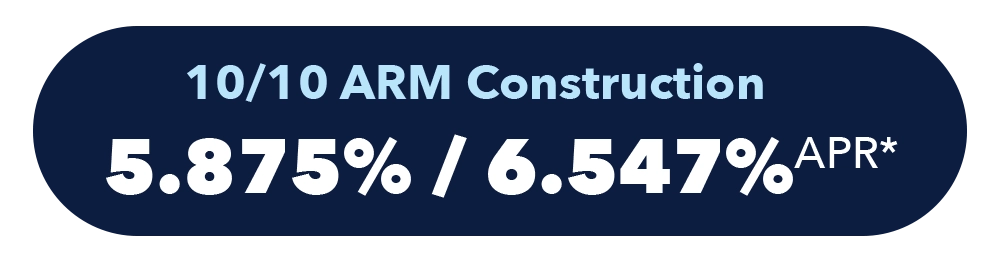
*Effective 9/16/2026 APR based on a 31-year term. Loan to Value (LTV) of 80% or less (20% down payment is required). APR is Annual Percentage Rate and is accurate as of effective date. APR is subject to increase after closing. The initial interest rate of 5.875%, APR 6.547% is fixed for 120 months, which includes a 12-month interest only construction period. After the first 120 months, the rate is variable and can increase or decrease every 120 months and will adjust based on the weekly average yield on United States Treasury Securities adjusted to a constant maturity of 10 year (currently 4.89%) plus our margin of (2.875%) rounded to the nearest (.125%). The maximum increase per adjustment period is (3.00%) with a maximum lifetime increase of (6%) over the initial rate. Based on current market conditions and a 5.875% initial interest rate, the payment schedule for an 80% Loan to Value (LTV) loan would be Interest due on the amount of credit outstanding during the aforementioned 12-month construction period paid monthly (estimated at $4,077.01 when fully advanced) followed by: 108 payments of $4,926.04 at an interest rate of 5.875 %, 251 payments of $ 6,242.85 at an interest rate of 8.875 %,1 payment of 6,240.28 at an interest rate of 8.875%. Monthly payments do not include taxes or insurance therefore, actual payment will be greater. This payment schedule is based on a $832,751 loan on a $1,040,939 property in New London County, CT. The assumed credit score is 740. Other terms and rates are available. All rates are subject to change daily. These rates are for loan amounts greater than $832,750, owner-occupied, single-family property. Rates subject to change. Monthly P & I payment may increase after consummation.